
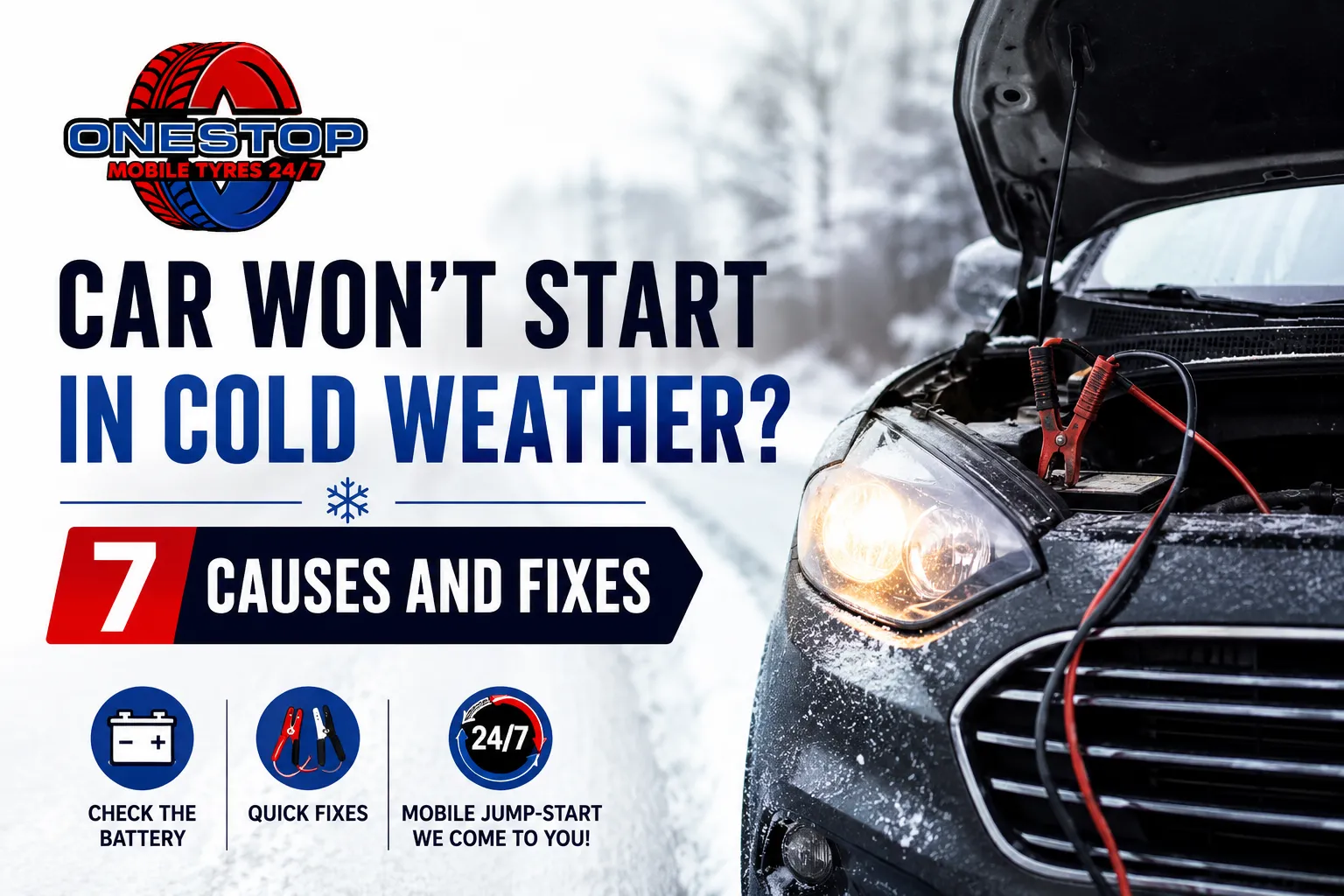
The Quick Answer
The most common reason a car will not start in cold weather is a weak or flat battery. Cold reduces what a battery can deliver while the engine needs more power to turn over. If the engine clicks, cranks slowly or the dashboard lights are dim, suspect the battery first. A jump-start usually gets you moving, and if you are stuck now, our mobile jump-start service can come to you.
What is your car telling you?
| Symptom | Most likely cause | First thing to try |
|---|---|---|
| Rapid clicking, engine does not turn | Flat or weak battery | Jump-start, then test the battery |
| Slow, heavy cranking | Weak battery or cold thick oil | Wait a minute and try again, then jump-start |
| Dashboard lights very dim or off | Flat battery or loose terminal | Check the terminals, then jump-start |
| Engine cranks normally but will not start | Fuel, spark or glow-plug issue | Try again in short bursts, then call a mechanic |
| One loud click, then nothing | Starter motor or connection fault | Check the connections, then get it tested |
| No sound and no lights | Totally flat battery or disconnected terminal | Check the battery terminals |
The 7 common causes
- Weak or old battery. Most car batteries last roughly 3 to 5 years, and cold exposes a tired battery first.
- Short journeys. Many short trips use more power starting the car than the alternator puts back.
- Left-on lights or electrics. Interior lights, a dash cam or a phone charger can drain a battery overnight.
- Loose or corroded terminals. A poor connection can mimic a flat battery.
- Thick engine oil. Cold oil makes the engine harder to turn.
- Fuel issues. Diesel can become harder to run in extreme cold, and water in the fuel system can cause problems.
- Starter or alternator fault. If the battery keeps going flat after a jump-start, the charging system may be at fault.
Quick checks before you call anyone
- Turn off all electrics, including heated seats, the radio and lights.
- Check that the battery terminals are tight and clean.
- Try the key or start button in short attempts of a few seconds. Long attempts drain the battery further.
- Make sure the car is in neutral or park, and that the clutch is pressed in if it is a manual.
When is a jump-start enough?
If the car starts after a jump and keeps running, drive for at least 20 to 30 minutes so the alternator can recharge the battery, then have the battery tested. If it will not start again or dies after a short time, the battery likely needs replacing or the charging system needs checking. Our mobile jump-start service at One Stop Mobile Tyres 24/7 comes to you across Greater Manchester. For the safe step-by-step method, read how to jump-start a car safely.
How to avoid a dead battery this winter
- Take a longer drive once a week.
- Switch off lights, heaters and chargers before you leave the car.
- Have an older battery tested before the cold sets in.
- Keep jump leads or a jump starter pack in the boot.
How cold weather affects a car battery
A car battery produces power through a chemical reaction, and cold slows that reaction down. At the same time, cold makes the engine oil thicker, so the starter motor needs more power to turn the engine over. A battery that has just enough reserve in summer can fail on the first frosty morning. This is why a tired battery often gives no warning until the weather turns. A quick jump start is often all it takes to get moving again.
How to test your battery at home
If you have a multimeter, set it to DC volts and test the battery with the engine off and the car rested for a few hours. These are approximate figures, so check your handbook for your own car. If you would rather not test it yourself, One Stop Mobile Tyres 24/7 can help.
| Reading (engine off) | What it suggests |
|---|---|
| About 12.6V or above | Fully charged |
| About 12.4V | Roughly three-quarters charged |
| About 12.0V or below | Effectively flat, needs charging or a jump |
| Drops sharply while cranking | Weak battery likely to fail soon |
With the engine running, a healthy charging system usually reads somewhere around 13.7 to 14.7V. A reading outside that range points to an alternator or charging problem. Many garages and tyre centres will test a battery quickly, so you do not need to buy equipment. Cold weather also affects your tyres, so check tyre pressure in cold weather too.
Petrol, diesel, hybrid and electric cars
- Petrol cars: Cold starts usually point to the battery, spark plugs or fuel supply.
- Diesel cars: Glow plugs warm the engine before starting. A glow plug fault or a very cold, thickened fuel can make starting harder.
- Stop-start cars: These need a specific type of battery, such as AGM or EFB. If you replace it, fit the correct type.
- Hybrid and electric cars: The big battery is separate from the small 12V battery that runs the car's systems. The 12V battery can still go flat and stop the car from starting. Jump-start procedures differ, so follow the handbook.
What not to do
- Don't keep cranking. Try for no more than about 10 seconds at a time, then wait around 30 seconds. Long attempts drain the battery and can overheat the starter.
- Don't jump-start a damaged battery. If the case is cracked, swollen or leaking, stop and call for help.
- Don't use starter sprays on a modern engine unless the manufacturer says it is safe.
- Don't push-start an automatic or a modern car unless the handbook allows it.
Signs your battery is nearing the end
- The engine turns over more slowly than it used to.
- Headlights dim when you start the car.
- The battery warning light appears on the dashboard.
- The battery is more than about four or five years old.
- You need a jump-start more than once.
- The terminals have white or blue-green corrosion.
If you notice more than one of these, get the battery tested before the next cold spell. A short test is cheaper than a breakdown. If you are already stranded, One Stop Mobile Tyres 24/7 offers roadside help across Greater Manchester, including our 24-hour emergency tyre fitting service.
Car won't start? We'll come to you.
Our technicians jump-start flat batteries at your home, work or roadside across Greater Manchester, day or night.