The Quick Answer
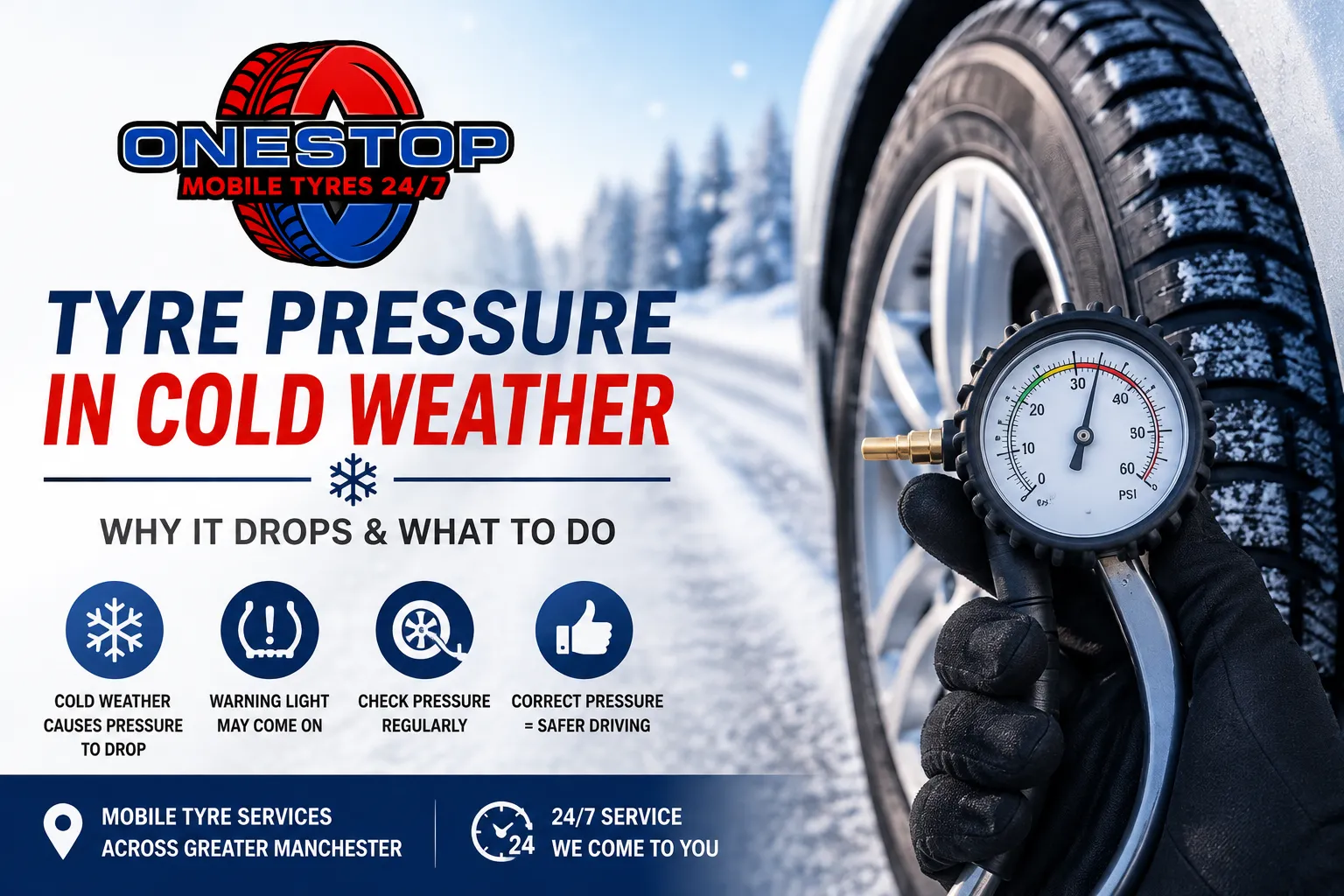
Air contracts as it cools, so tyre pressure falls when the temperature drops. A cold snap can take enough pressure out to trigger your tyre pressure warning light. Check your pressures when the tyres are cold, top up to the figure in your car's handbook, and check again every few weeks through winter. If the light keeps coming back, One Stop Mobile Tyres 24/7 can help.
Why does tyre pressure drop when it's cold?
The air inside a tyre behaves like any gas: when it cools, it takes up less space and the pressure falls. As a rule of thumb, tyre pressure drops by about 1 PSI for every 5 to 6°C fall in temperature. A tyre that was correct in September can be noticeably low by December without any puncture. If you keep topping up the same tyre, book emergency puncture repair.
Why does the warning light come on in the morning?
Many cars have a tyre pressure monitoring system (TPMS) that warns you when a tyre is well below its target pressure. The coldest point of the day is early morning, so a tyre that is already slightly low can cross the warning threshold overnight. The light may go out once the tyres warm up as you drive, but that does not mean the pressure is correct. Check it anyway. If it keeps returning, a TPMS reset may be needed.
How often should you check your tyre pressure?
| Situation | How often |
|---|---|
| Normal driving | At least once a month |
| Winter or sudden cold snap | Every 2 to 3 weeks, and after a big temperature drop |
| Before a long motorway trip or with a full load | Every time |
| After a warning light | Straight away |
Where do I find the correct pressure?
Use the figure for your own car, not the number printed on the tyre sidewall. That sidewall figure is the tyre's maximum. Your correct pressures are normally in the vehicle handbook, on a sticker inside the driver's door frame or on the fuel flap. Many cars list different pressures for normal and fully loaded. A fitter can confirm the right figure during a mobile tyre fitting visit.
How to check and adjust your tyre pressure
- 1Check when the tyres are cold, ideally before driving or after the car has been parked for a few hours.
- 2Remove the valve cap and press a reliable gauge firmly onto the valve.
- 3Compare the reading with the figure for your car.
- 4Add air in short bursts and re-check until you reach the target. If you overshoot, release a little air.
- 5Refit the valve caps and repeat on every tyre, including the spare if it is a full-size or space-saver wheel that has its own pressure.
The warning light stays on after you've inflated the tyres
If the light stays on after all four tyres are at the right pressure, there are three common causes: the system needs resetting, a sensor has a flat battery or fault, or one tyre has a slow puncture. If you suspect a slow puncture, read our guide on slow puncture signs. If the system just needs a reset, our TPMS reset service at One Stop Mobile Tyres 24/7 can clear the light at your home or workplace across Greater Manchester. Call 0161 399 5851.
Direct and indirect TPMS: why the light behaves differently
There are two main types of tyre pressure monitoring system. A direct system has a pressure sensor inside each wheel and reads the actual pressure. An indirect system uses the ABS wheel-speed sensors to spot a tyre that is spinning faster than the others, which usually means it has lost air and has a smaller diameter. Indirect systems normally need to be reset after you inflate the tyres. Both types can trigger in cold weather. Direct sensors run on small batteries that eventually wear out, usually after several years, and a failing sensor can keep the light on even when the pressure is correct.
Should you inflate above the recommended pressure in winter?
No. Use the pressure your car's maker recommends. Over-inflating reduces the area of rubber touching the road, which lowers grip and can wear the middle of the tread faster. Some handbooks list a higher pressure for a fully loaded car or sustained high speeds, and you should use that figure only in those situations. Correct pressure also helps tyres cope with rough roads, as we explain in our pothole tyre damage guide.
Why correct pressure matters beyond the warning light
| Area | What happens when pressure is too low |
|---|---|
| Safety | The sidewalls flex more and heat up, which raises the risk of a blowout at speed |
| Grip and braking | Handling feels vague and stopping distances can increase |
| Tyre wear | The outer edges wear faster and the tyre needs replacing sooner |
| Fuel economy | More rolling resistance means the engine works harder |
| Comfort | The steering can feel heavy and less precise |
Common tyre pressure mistakes
- Checking after a long drive. Warm tyres give a higher reading, so you may think the pressure is fine when it is not.
- Using the sidewall figure. That number is the tyre's maximum, not your car's recommended pressure.
- Forgetting the spare. A full-size spare or a space-saver wheel has its own pressure and loses air over time.
- Relying on the light alone. By the time the warning appears, a tyre can already be well below its target pressure.
- Not resetting after inflating. On indirect systems the light may stay on until you reset it.
A simple winter pressure routine
- Buy a reliable digital or dial tyre gauge and keep it in the glovebox.
- Set a monthly reminder, and add a check after any sharp cold snap.
- Check first thing in the morning, before you drive.
- Write your correct pressures in your phone so you do not have to look them up.
- If a tyre needs topping up every week, have it inspected for a slow puncture.
Tyre pressure light won't go off?
We'll check all four tyres, look for slow punctures and reset your TPMS at your home or workplace anywhere in Greater Manchester.