
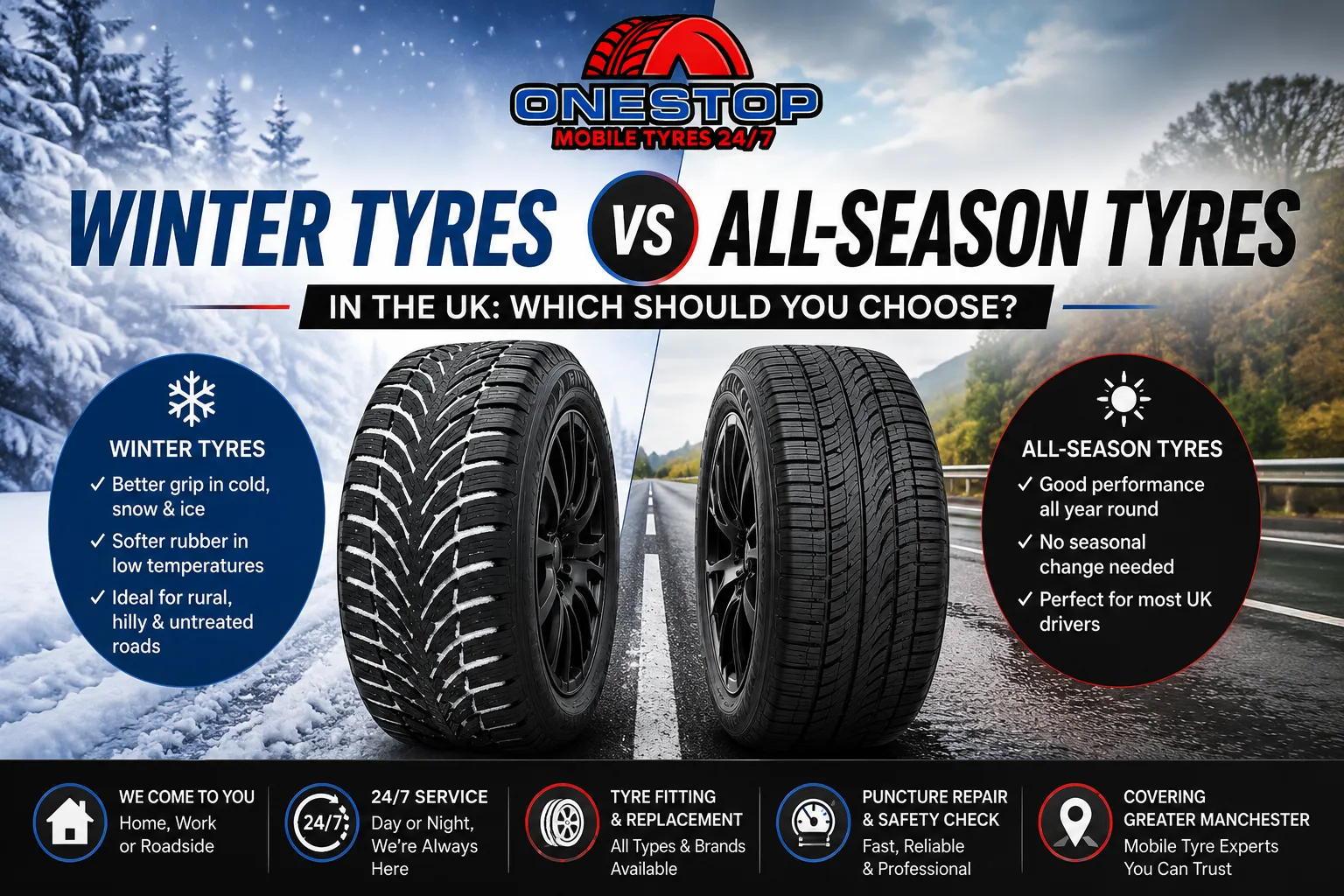
The Quick Answer
If you drive mostly in towns and on main roads, good all-season tyres are enough for most UK winters. Winter tyres give better grip once temperatures stay low, and they suit hilly, rural or untreated roads. Neither is a legal requirement in the UK. If you would rather have them fitted at home or work, One Stop Mobile Tyres 24/7 can help across Greater Manchester.
Winter tyres vs all-season tyres at a glance
| Winter tyres | All-season tyres | Summer tyres | |
|---|---|---|---|
| Best temperature range | Cold, roughly below 7°C | Mild to cold, year-round | Warm, above 7°C |
| Grip on cold, wet and icy roads | Best | Good | Reduced |
| Grip on snow | Best | Good if marked with the three-peak mountain snowflake symbol | Poor |
| Wear in hot weather | Faster | Moderate | Slowest |
| Needs a second set and storage | Yes | No | Only if paired with winter tyres |
| Typical buyer | Rural, hilly or high-mileage drivers | Most UK drivers | Drivers who rarely face cold or snow |
Why temperature matters more than snow
Most UK winters bring cold, wet roads far more often than snow. Winter tyres use a softer rubber compound that stays flexible when it is cold, so they keep gripping when summer-type rubber starts to harden. A commonly cited guideline is that winter tyres start to make a difference once temperatures regularly fall below about 7°C.
Are winter tyres a legal requirement in the UK?
No. Unlike some European countries, the UK has no law that requires winter tyres. Whatever tyres you run must still be legal: at least 1.6mm of tread across the central three-quarters of the tread and around the whole circumference, correct pressure, and no damage.
What does the "3PMSF" symbol mean?
Look for a mountain with three peaks and a snowflake on the sidewall. It shows a tyre has passed a severe snow test. The letters "M+S" on their own are a weaker marking and do not guarantee the same snow performance. Genuine all-season tyres usually carry the snowflake symbol.
How much do they cost?
Winter and all-season tyres are usually priced similarly to premium summer tyres of the same size. The extra cost with winter tyres is the second set of wheels or the seasonal swap fee, plus somewhere to store the off-season set. All-season tyres avoid both, which is why they suit many drivers. If you are watching the budget, see our cheap mobile tyre fitting page.
When should you fit them?
Fit winter tyres when daytime temperatures begin to stay low, usually from October or November, and swap back in spring. Do not wait for the first frost: fitters get busy in the first cold snap. Cold snaps also drain batteries, so if your car won't start in cold weather, we can help with that too.
Can a mobile fitter swap them at home?
Yes. A mobile fitter can swap a set of wheels, or change tyres on your drive or at work, so you do not need to lose half a day at a garage. At One Stop Mobile Tyres 24/7, our home tyre fitting and mobile tyre fitting service covers Greater Manchester. Call 0161 399 5851 and tell us your car, tyre size and whether you want a swap or new tyres.
How winter tyres actually work
Winter tyres differ from summer tyres in three ways.
- Rubber compound. Winter tyres use a softer mix with more silica, so the rubber stays flexible in the cold. Summer rubber stiffens as the temperature falls, which reduces how well it grips the road.
- Tread pattern. Deeper, wider grooves clear water, slush and snow from under the tyre. This reduces aquaplaning and lets the tread bite into snow.
- Sipes. These are thousands of tiny slits cut across the tread blocks. They create extra gripping edges on cold, wet and icy surfaces.
All-season tyres sit in the middle. Their compound is a compromise that works across a wider temperature range, so they cope far better than summer tyres in winter, but they do not match a dedicated winter tyre in deep snow or on ice.
Which tyre suits which driver?
| Your driving | Better choice | Why |
|---|---|---|
| Short town journeys, mostly main roads | All-season | Main roads are usually gritted, and you avoid buying a second set |
| Rural roads, hills or early starts on untreated roads | Winter tyres | Best grip on cold, damp and icy surfaces |
| High-mileage motorway driving | All-season, or summer tyres with careful winter checks | Winter tyres wear faster in warm weather |
| A car used only occasionally | All-season | No storage, and the tyres are not left unused |
| Van, taxi or work vehicle on the road all winter | Winter or all-season | Reliability and safety matter more than saving on a set |
| Electric car | Tyres rated for the car's weight and torque | EVs are heavier and need tyres designed for them |
Common winter tyre mistakes
- Fitting only two winter tyres. Fit all four. Winter tyres on one axle only can leave the car unbalanced and more likely to slide.
- Waiting for the first snow. By then fitters are fully booked, and stock of popular sizes can run low.
- Ignoring tread depth. The legal minimum is 1.6mm, but winter tyres work best with plenty of tread. Many drivers replace them earlier, so follow your tyre maker's advice.
- Forgetting pressure. Cold air lowers pressure, so check regularly through the season. See our guide on tyre pressure in cold weather.
- Running them all year. Winter tyres wear quickly and lose sharpness on warm roads. Swap back in spring.
- Storing them badly. Keep off-season tyres cool, dry and out of direct sunlight, and away from oil and solvents.
Winter tyre checklist
- Check tread depth on all four tyres.
- Inspect the sidewalls for cracks, cuts or bulges.
- Check the age of each tyre using the DOT code. Many manufacturers advise regular inspections from about five years and replacement at around ten.
- Set the pressures to your car's recommended figures.
- Book your swap or new tyres early.
- Keep an ice scraper, torch, blanket and charged phone in the car.
Want your winter or all-season tyres fitted at home?
Tell us your car and tyre size and we'll quote for a seasonal swap or new tyres, fitted on your drive or at work across Greater Manchester.