
The Quick Answer
If you get a flat tyre on the M60 or any motorway: slow down gradually, signal left, and get off the carriageway— an exit slip, service area or emergency area if you can reach one, the hard shoulder if you can't. Stop as far left as possible, put your hazards on, get everyone out of the left-hand doors and behind the barrier, then call for help from there. Never attempt to change a wheel yourself on a live motorway.
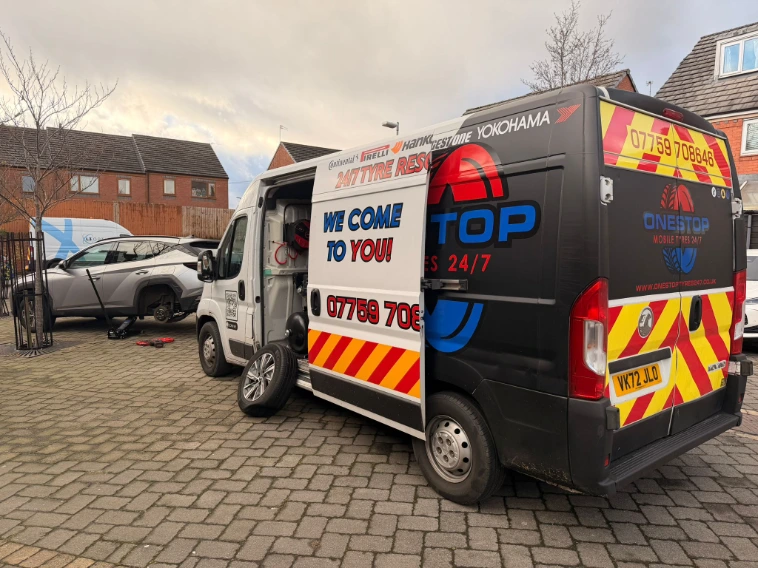
Once you're somewhere safe, our 24/7 mobile technicians can come to you and repair or replace the tyre on the spot. Call 07759 708 646 — we prioritise motorway call-outs, day and night.
A flat tyre at 70mph is frightening, and the M60 — with its constant traffic, smart-motorway sections and closely spaced junctions — is one of the worst places in the country for it to happen. The good news: if you follow the right sequence of steps, you and your passengers stay safe, and getting moving again is usually far quicker and cheaper than people expect. Here's the full sequence, in order.
Step 1: Keep Control and Slow Down Gradually
If the tyre deflates suddenly — or blows out — the car will pull to one side and you may hear a loud flapping or rumbling. The instinct is to brake hard. Don't.
- Grip the wheel firmly with both hands and keep the car straight.
- Ease off the accelerator and let the car slow down on its own — brake only gently once speed has dropped.
- Put your hazard lights on and start moving towards the left-hand lane when it's clear.
Step 2: Choose the Safest Place You Can Reach
In order of preference — take the best option your tyre will allow:
| Where to stop | When |
|---|---|
| Leave at the next junction or services | If the tyre is deflating slowly and the exit is close — reduce speed and use the left lane |
| Emergency area (orange SOS bay) | On smart-motorway sections of the M60 and M62 with no hard shoulder — signed every ~1 mile |
| Hard shoulder, as far left as possible | If you can't make an exit — wheels turned left, hazards on |
| Where you are, in lane | Only if the car is undriveable — hazards on, stay belted, call 999 immediately |
Step 3: Get Yourself and Your Passengers Safe
- Stop as far to the left as you can, with your wheels turned to the left.
- Keep your hazard lights on; use sidelights too in poor visibility or at night.
- Get everyone out through the left-hand doors, away from traffic.
- Move up the bank or behind the safety barrier if there is one, and stand upstream of your car (traffic side facing you) so you can see approaching vehicles.
- Leave pets in the car unless it's unsafe to do so.
- Do not place a warning triangle on a motorway, and do not attempt any wheel change yourself.
If you're stuck in a live lane, cannot leave the vehicle safely, or you're on a smart-motorway stretch with no hard shoulder: stay belted in, keep your hazards on, dial 999. National Highways (0300 123 5000) can also close your lane using the overhead signs.
Step 4: Call a Mobile Tyre Fitter — Not Necessarily a Recovery Truck
Most drivers assume a motorway flat means an expensive tow to a garage. Usually it doesn't. Once you're at a service station, slip road, lay-by or emergency area — or once National Highways has moved you somewhere safe — a mobile technician can come to you with the right size tyre and sort it on the spot:
- If the damage is a small tread puncture, a proper BS AU 159 repair may be possible — see our guide to whether a tyre can be repaired or needs replacing. Motorway-speed blowouts, though, almost always mean replacement.
- Our mobile tyre fitting service carries premium, mid-range and budget tyres and fits the replacement where you stand — wheel off, new tyre on, balanced, TPMS checked.
- It's a genuine 24 hour emergency service — a 3am blowout on the M62 gets the same response as a 3pm one.
One honest caveat, because it matters for your safety: no fitter will change a tyre on a live hard shoulder. If that's where you are, we'll talk you through reaching the nearest safe stopping point — there's almost always a service area or slip road within a couple of junctions on the motorway network — and meet you there.
Know Your Road: Safe Stopping Points on Your Route
M60 ring road
No motorway services on the orbital itself, but exits come every mile or two — junctions 1, 12 and 18 all have fuel stations and retail parks within minutes of the slip road.
M62
Birch Services (between J18 and J19) is the obvious safe haven on this stretch — we attend it regularly.
M56
The airport sits between J5 and J6; the terminal approach roads, drop-off areas and business parks all make safe meeting points.
M61
Rivington Services (northbound between J6 and J8) — or drop off at J6 for the Middlebrook retail park.
M66 / M67 / M602 / A627(M)
These are short commuter routes — the next exit is never more than a few minutes away, and each leads quickly to town-centre car parks or fuel stations where we can work safely.
Reduce the Odds Before You Join the Motorway
Most motorway tyre failures start as slow problems that were visible days earlier. Before a long run on the M60 or M62:
- Check pressures when the tyres are cold — underinflation is the biggest cause of high-speed blowouts.
- Look for bulges, cuts and embedded nails or screws — and check tread with the 20p test.
- Don't ignore a TPMS warning light — it usually means a slow puncture. Our TPMS reset service can diagnose the sensor and the tyre together.
Stranded on the motorway right now?
Get somewhere safe first, then call us. Tell us your motorway and nearest junction number — we'll confirm the best meeting point and dispatch the nearest technician straight away.